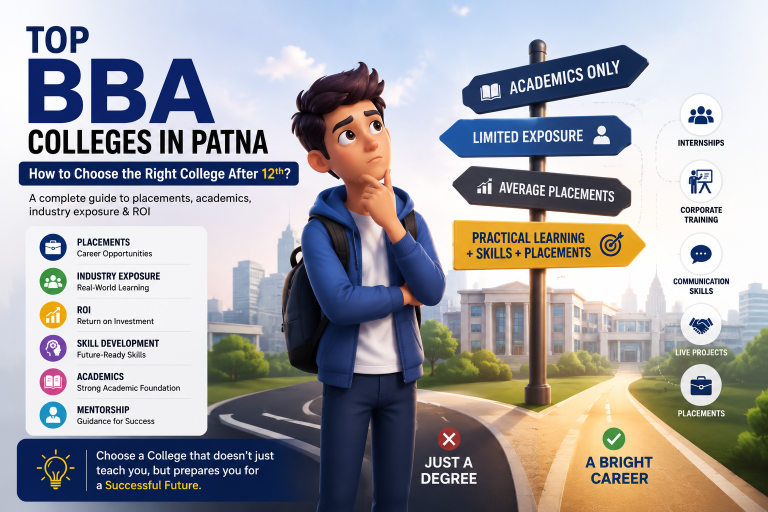
Choosing a college requires looking beyond rankings and appearances to understand academics, exposure, opportunities and career outcomes.
Choosing a college after Class 12 is about much more than selecting a name from a list.
For students in Patna and across Bihar, the number of higher-education options has grown considerably. Colleges and universities now highlight modern classrooms, industry connections, placement records, technology-enabled learning, extracurricular activities and attractive campuses.
All of these can matter. But they can also make the decision more confusing.
A college may have an impressive-looking building but limited practical exposure. Another may have a strong academic reputation but a less aggressive placement system. A newer institution may offer modern teaching methods but have a shorter track record of alumni outcomes. An established institution, meanwhile, may have years of experience but a different approach to campus life.
So, how should students actually choose the right college in Patna?
The answer lies in looking beyond advertisements and evaluating the complete educational ecosystem — from academics and faculty to placements, industry exposure, infrastructure, student development and alumni outcomes.
What Should Students Look for in a College?
There is no single parameter that can determine whether a college is right for everyone.
A more meaningful evaluation should consider several factors together:
- Academic quality
- Teaching methodology
- Faculty experience
- Student results
- Placement support
- Industry interaction
- Internship opportunities
- Practical learning
- Infrastructure
- Innovation and technology exposure
- Industrial visits
- Events and activities
- Sports and student life
- Alumni outcomes
- Affordability and return on investment
The importance of each factor depends on the student’s goals.
Someone preparing for higher studies may prioritise academic depth. A student looking for employment after graduation may give greater importance to practical skills, internships and placement preparation. Another student may place greater value on campus facilities, sports and extracurricular activities.
The right college is therefore not necessarily the one that scores highest on every parameter. It is the one that provides the right combination of opportunities for the student’s goals.
1. Start With the Academic Environment
Academics remain the foundation of any college.
Before considering placement packages or campus facilities, students should understand how the institution approaches teaching and learning.
A strong academic environment generally includes:
- A structured curriculum
- Regular classes
- Qualified and experienced faculty
- Academic mentoring
- Practical assignments
- Projects and presentations
- Continuous assessment
- Opportunities for discussion and problem-solving
However, the way a subject is taught can be just as important as what is taught.
Traditional classroom teaching can provide conceptual foundations, while discussions, presentations, projects, case studies and practical assignments can help students apply those concepts.
This is particularly important in professional and technology-oriented education, where students eventually need to use what they learn in real-world situations.
Theory alone is no longer enough
Today’s graduates enter workplaces where employers expect more than academic knowledge.
Communication, teamwork, problem-solving, digital literacy, presentation skills and professional behaviour can influence employability significantly.
Therefore, when visiting a college, students should ask:
How much of the learning happens beyond textbooks?
That simple question can reveal a lot about the institution’s educational approach.
2. Look at the Teaching Methodology, Not Just the Curriculum
Two colleges can offer similar academic programmes but create very different learning experiences.
Some institutions may rely heavily on lectures and examinations. Others may combine classroom teaching with:
- Group discussions
- Presentations
- Case-based learning
- Practical assignments
- Live projects
- Workshops
- Skill-development sessions
- Industry-led sessions
Neither approach should automatically be labelled superior.
The more important question is whether students are given opportunities to understand, apply and communicate what they learn.
For example, a management student can learn marketing principles from a textbook. But analysing an actual campaign, presenting a business idea or conducting basic market research creates a different kind of learning experience.
Similarly, a technology student can study programming concepts in class, but developing a working project requires application.
The best learning environments tend to create a connection between the two.
3. Faculty Can Shape the Student Experience
A college’s infrastructure may attract a student initially, but faculty members influence the day-to-day learning experience.
Students should look beyond designations and ask how accessible and involved the faculty actually are.
Useful questions include:
- Do teachers encourage questions?
- Are students given individual guidance?
- Are projects properly mentored?
- Do faculty members use practical examples?
- Is there academic support when students struggle?
- Are students encouraged to participate in discussions and presentations?
Experienced faculty can also help students understand how classroom concepts connect with professional environments.
This is particularly valuable for students coming directly from school, who are still adapting to higher education and gradually developing independent learning habits.
4. Placement Should Be Evaluated Through Evidence
Placement is one of the most important considerations for students and parents.
But it is also one of the areas where students should be most careful.
A college website may highlight its highest package or a few well-known recruiters. Those details can be useful, but they do not tell the complete story.
A better placement evaluation should consider:
- Number of students placed
- Placement rate, where reliably reported
- Course-specific placement data
- Recruiters
- Job roles
- Salary ranges
- Internship opportunities
- Placement preparation
- Number and type of hiring drives
- Alumni career progression
Why course-specific data matters
Suppose an institution offers engineering, management, commerce and computer applications.
If its website reports the highest package across the entire institution, that number should not automatically be interpreted as the expected package for every programme.
Students should ask:
“What were the placement outcomes for the programme I am actually joining?”
This is a much more meaningful question.
The same principle applies when comparing colleges.
A responsible comparison should use comparable information rather than mixing institutional averages, individual success stories and unrelated programmes.
5. Placement Preparation Matters as Much as Recruiter Names
A college’s role in placements does not begin when a company announces a vacancy.
Preparation can start much earlier.
Students may need support in:
- Aptitude
- Quantitative reasoning
- Logical reasoning
- Verbal ability
- Communication
- Group discussions
- Personal interviews
- Resume preparation
- Professional etiquette
- Company-specific assessments
The source material reviewed for this article describes structured preparation at CIMAGE for competitive hiring processes, including aptitude and verbal preparation associated with companies such as Deloitte. It also makes an important distinction: such opportunities can involve national or pooled hiring processes rather than exclusive recruitment by the institution.
That distinction is worth remembering.
A student being eligible for a national hiring assessment is an opportunity. Selection still depends on the student’s performance.
Placement is not a guarantee
No college can realistically guarantee that every student will receive the same job or salary.
The strongest placement systems can provide:
training → opportunity → assessment → interview → selection
But the student’s preparation and performance remain critical.
That is why students should evaluate both the institutional ecosystem and their own willingness to participate in it.
6. Industry Exposure Bridges the Gap Between College and Work
One of the biggest differences between classroom education and professional life is context.
Students may understand a concept academically but still have little idea how organisations actually operate.
Industry interaction can help bridge that gap.
It can include:
- Guest lectures
- Corporate sessions
- Workshops
- Industrial visits
- Internship programmes
- Live projects
- Alumni interactions
- Expert mentoring
- Company-specific training
For students, the value of these activities is not simply collecting certificates.
A good industry interaction should help answer practical questions:
How does this industry work?
What skills do employers expect?
What does a typical professional role involve?
What mistakes should a fresher avoid?
What skills should I develop before graduation?
This kind of exposure can make career planning more realistic.
7. Industrial Visits: More Than a Change of Location
Industrial visits are sometimes treated as just another college activity.
Their real value depends on how they are conducted.
A meaningful industrial visit can allow students to observe:
- Workplace processes
- Production or service operations
- Organisational structure
- Technology usage
- Employee roles
- Quality systems
- Business operations
- Professional work culture
The difference lies in whether students are simply taken somewhere for a few hours or whether the visit is connected to classroom learning.
A well-planned visit can turn an abstract concept into something students can actually observe.
8. Infrastructure Should Be Judged by Function, Not Appearance
Infrastructure is one of the easiest things to market visually.
Large buildings, modern interiors and attractive classrooms naturally create a strong first impression.
But infrastructure is more than appearance.
Students should look for facilities that directly support education, such as:
- Classrooms
- Computer laboratories
- Libraries
- Digital learning resources
- Seminar spaces
- Project areas
- Training facilities
- Student activity spaces
- Sports facilities, where available
The better question is not:
“Which college building looks better?”
It is:
“How does the infrastructure improve the student’s learning experience?”
Dedicated academic space matters
Students should also understand the nature of the institution’s physical setup.
Is there a dedicated academic environment?
Are classrooms and laboratories designed specifically for students?
Are learning spaces separate from unrelated commercial activities?
Is there enough room for students to interact, participate in activities and use facilities?
These practical questions can reveal more than photographs on a website.
The earlier comparison in the source material makes precisely this distinction between a visually attractive setup and functional academic infrastructure.
9. A Modern Campus Is Valuable — But It Is Not Everything
A larger campus can offer genuine advantages.
Open spaces, sports facilities, auditoriums, student clubs and activity areas can contribute to college life.
But campus size should not become the sole measure of educational quality.
A smaller institution can still provide strong academic facilities, laboratories, industry interaction and career preparation.
Conversely, a large campus does not automatically guarantee better learning outcomes.
Students should therefore evaluate utility alongside appearance.
A useful infrastructure checklist is:
| What to Check | Why It Matters |
| Classrooms | Daily learning environment |
| Computer labs | Practical and digital learning |
| Library | Academic resources |
| Seminar spaces | Presentations and expert sessions |
| Project areas | Collaborative learning |
| Activity spaces | Student development |
| Sports facilities | Physical activity and recreation |
| Campus environment | Overall student experience |
10. Innovation Should Mean Student Output
The word “innovation” appears frequently in modern education marketing.
But innovation should not be measured only by the presence of a laboratory or a technology-themed event.
A stronger measure is:
What are students actually doing?
Innovation-oriented education can involve:
- Building projects
- Developing applications
- Working with robotics
- Exploring AI and IoT
- Data analysis
- Solving real-world problems
- Entrepreneurship projects
- Technology workshops
- Prototyping
- Mentored experimentation
The CIMAGE ecosystem described in the source material includes exposure to AI, IoT, robotics, data science, drones, AR/VR and project-based activities.
The important point, however, is not simply that these facilities or activities exist.
Students should ask:
How frequently are students actually using them?
That is a much stronger indicator of meaningful innovation.
11. Technology Is Becoming Relevant Across Disciplines
Technology is no longer limited to computer science classrooms.
Management students increasingly work with analytics and digital platforms.
Commerce students use financial and accounting software.
Marketing students work with digital campaigns and data.
Operations increasingly depends on automation and analytics.
This makes digital literacy valuable across disciplines.
Students do not necessarily need to become programmers. But understanding technologies such as analytics tools, AI-enabled productivity tools, cloud platforms and digital business systems can improve their ability to work in modern organisations.
A college that encourages students to develop these complementary skills can provide an advantage beyond the core curriculum.
12. Alumni Outcomes Tell a Longer Story
A placement tells you about the beginning of a career.
An alumni network can tell you what happens afterwards.
This is why students should not look only at first jobs.
Useful questions include:
- Where are older graduates working?
- What roles do they hold today?
- Have graduates moved into managerial positions?
- Have they moved to larger organisations?
- Are they working outside Bihar?
- Are there examples of entrepreneurship?
- Have graduates moved into technology, consulting, banking or other professional fields?
The available LinkedIn research provides an interesting example.
Publicly visible alumni data showed a strong concentration of CIMAGE alumni in companies such as TCS and Wipro, while institutions such as Patna Women’s College and Magadh Mahila showed broader and more diversified alumni footprints.
This illustrates why one number should never be treated as a complete definition of an institution.
A high concentration in particular employers may indicate a strong corporate pipeline, while a broader alumni network may indicate greater diversity of career paths.
Both are meaningful.
13. Look Beyond the First Job
Career progression can sometimes be more informative than the first placement.
The alumni research reviewed for this article identified CIMAGE graduates who had progressed into organisations and roles associated with companies such as Microsoft, Amazon, PwC, KPMG, Coforge and HSBC. The source explicitly cautions that these are examples of career mobility rather than proof that those companies directly recruited every graduate from campus.
That distinction matters.
A graduate might begin with an entry-level IT or business role, build skills for several years and later move into a larger organisation.
The career journey may look something like:
Graduation → first job → experience → certifications/upskilling → better role → career progression
A college should therefore be judged not only by the first destination, but also by whether it gives students the foundation to keep progressing.
14. College Life Matters Too
Career preparation is important, but college is also a formative period of a student’s life.
Students should have opportunities to develop:
- Confidence
- Leadership
- Teamwork
- Communication
- Creativity
- Social skills
- Decision-making
Events, competitions, cultural programmes, seminars, clubs, sports and student activities can all contribute.
Some institutions may have a highly career-oriented culture, while others may emphasise campus life and extracurricular participation more heavily.
There is no universal answer.
A student who wants an intensive professional environment may prefer one model.
Another student may value a broader campus experience.
The right choice depends on what the student expects from the next three or four years.
15. Events and Activities Should Have a Purpose
A long list of events does not automatically mean strong student development.
The better question is:
What does the student gain from participating?
For example:
- A business competition can develop decision-making.
- A presentation can improve communication.
- A hackathon can develop problem-solving.
- A cultural event can build teamwork.
- A sports activity can encourage discipline and collaboration.
- An industry seminar can improve career awareness.
When activities are connected to student development, college life becomes an extension of education rather than something separate from it.
16. Sports and Physical Activities Should Not Be Ignored
Students spend several years at college, and a healthy college experience should not be limited to classrooms.
Sports and physical activities can encourage:
- Teamwork
- Discipline
- Time management
- Leadership
- Stress management
- Healthy competition
Students who value sports should check what facilities and opportunities are actually available rather than assuming that every institution offers the same experience.
17. Compare Institutions According to Their Strengths
Students often ask:
“Which is the best college in Patna?”
The more useful question is:
“Which college is best for my priorities?”
For example:
| Student Priority | What to Examine |
| Immediate career preparation | Placement training and recruiter ecosystem |
| Strong academics | Faculty, curriculum and academic mentoring |
| Practical learning | Projects, labs and assignments |
| Industry exposure | Visits, internships and expert sessions |
| Technology exposure | Labs, digital tools and emerging technologies |
| Entrepreneurship | Innovation, mentoring and startup activities |
| Campus experience | Infrastructure, sports, clubs and events |
| Higher studies | Academic foundation and entrance preparation |
| Long-term career growth | Alumni outcomes and career progression |
| Value for money | Total cost versus realistic outcomes |
This approach avoids the problem of creating a single ranking based on completely different types of institutions.
18. What Can Students Learn From Comparing Patna Institutions?
A comparison of institutions in Patna reveals something important: different colleges can be strong in different areas.
The alumni research reviewed for this article, for example, found:
- CIMAGE showing a particularly strong visible concentration of alumni in large IT/services employers such as TCS and Wipro.
- Patna Women’s College showing a larger and more diversified alumni ecosystem.
- Magadh Mahila showing notable banking as well as IT-sector representation.
- Amity Patna having a comparatively younger alumni base, making long-term comparisons more difficult.
- Arcade showing a genuine presence in companies including Wipro, TCS, Genpact and Bajaj Finserv.
- Publicly indexed information being insufficient for equally detailed employer comparisons for some institutions.
This is exactly why responsible college comparison requires context.
A newer institution should not automatically be judged against a century-old institution on alumni depth.
A college with a strong IT-employment pipeline should not automatically be called the best overall institution.
And an attractive campus should not automatically be equated with better academic outcomes.
19. Where CIMAGE Fits Into This Picture
Within this broader framework, CIMAGE represents a model that places considerable emphasis on career-oriented education, practical learning and industry exposure.
Its institutional ecosystem includes:
- Professional undergraduate and postgraduate programmes
- Skill-development initiatives
- Placement preparation
- Industry interaction
- Workshops and seminars
- Practical projects
- Technology exposure
- Entrepreneurship and innovation activities
- Alumni connections
- Career guidance
The source material also describes CIMAGE’s structured preparation for national-level recruitment processes and its participation in hiring opportunities involving organisations such as Deloitte. Importantly, those opportunities should be understood as competitive recruitment processes rather than automatic placement guarantees.
The alumni data provides another perspective.
The publicly visible LinkedIn footprint reviewed in the source material showed CIMAGE with approximately 2,252 visible alumni, with TCS and Wipro among its most prominent employers. The research also found evidence of career progression beyond initial employment.
For students who place a high value on employability and professional exposure, this is an aspect worth examining.
But the same principle applies here as it does to every institution:
Students should verify current information and choose according to their own goals.
20. Don’t Choose a College Only on the Basis of Rankings
Rankings can be useful as a starting point.
They should not be the final decision.
There are several reasons.
Different rankings may use different methodologies.
One may emphasise academic reputation. Another may consider infrastructure. Another may look at placements or research.
Students also have different priorities.
A college ranked highly overall may not necessarily be the best fit for a student seeking a particular learning environment or career pathway.
Instead of asking:
“What is the rank?”
ask:
“What evidence supports the strengths that matter to me?”
21. Don’t Judge a College Only by Its Highest Package
This deserves special attention.
A highest package is an outlier.
It tells you that at least one student achieved a particular outcome. It does not tell you what the typical student can expect.
Students should look for:
- Median or average salary, where reliably available
- Number of students placed
- Programme-wise results
- Job roles
- Recruiter diversity
- Internship opportunities
- Placement preparation
- Alumni progression
This approach gives a much more realistic picture.
22. Don’t Confuse Opportunity With Guarantee
A strong college can provide opportunities.
It can bring companies or hiring assessments.
It can conduct training.
It can arrange internships.
It can organise industry interactions.
But students still have to participate.
The difference between two students in the same classroom can be significant.
One may attend workshops, complete projects, improve communication, prepare for assessments and seek internships.
Another may only attend classes and prepare for semester examinations.
The institution creates the environment.
The student determines how much of that environment becomes an outcome.
23. A College Visit Can Tell You What a Website Cannot
Before finalising admission, students should visit their shortlisted institutions.
During the visit, observe:
Classrooms
Are students engaged? Are classrooms functional?
Laboratories
Are the systems available and being used?
Library
Is it simply a room with books, or do students actually use it?
Faculty interaction
Can students approach teachers?
Student activity
Are there visible clubs, events, projects or competitions?
Placement cell
Can the institution explain its placement process clearly?
Campus environment
Does the physical environment feel suitable for several years of study?
Student feedback
What do current students say about academics, placements and daily college life?
These observations can be more valuable than promotional material.
24. Questions Parents Should Ask Before Admission
Parents often focus heavily on fees and placement.
Both are important, but there are additional questions worth asking:
- What is the complete cost of education?
- Are there additional charges?
- What support is available if the student struggles academically?
- How are internships facilitated?
- What does placement preparation involve?
- How are placement statistics calculated?
- What are the actual job roles offered?
- What is the attendance policy?
- What facilities are available?
- What opportunities exist beyond academics?
A transparent institution should be able to answer these questions clearly.
25. A Practical College-Selection Checklist
Before taking admission, students can use this checklist:
- Check the institution’s affiliation and approvals.
- Review the curriculum.
- Meet or observe faculty members.
- Visit classrooms and laboratories.
- Check library and digital resources.
- Ask for course-specific placement information.
- Examine recruiter and job-role details.
- Ask about internships.
- Understand the placement preparation process.
- Ask about industry visits and expert sessions.
- Explore student projects and practical learning.
- Check sports and extracurricular opportunities.
- Speak with current students.
- Review total fees and additional costs.
- Consider travel and daily convenience.
- Compare the institution with at least two or three alternatives.
- Match the college with your long-term career goal.
26. The Real Meaning of “A Good College”
A good college is not necessarily the institution with:
- The largest building
- The highest advertised package
- The longest list of recruiters
- The most social-media followers
- The biggest event
- The most expensive infrastructure
Instead, a strong institution should create a combination of:
learning + skills + exposure + opportunities + guidance
That combination is what can help students move from being school graduates to confident young professionals.
Conclusion
Choosing the right college in Patna requires more thought than comparing names, rankings or advertisements.
Students should look at the complete picture:
How strong are the academics?
How experienced and accessible are the faculty?
Does learning include practical exposure?
How transparent is the placement record?
What kind of industry interaction is available?
Is the infrastructure functional and student-oriented?
What opportunities exist for innovation, internships and projects?
What do alumni outcomes look like over time?
What kind of college life does the institution offer?
The answers to these questions can reveal much more than a brochure ever will.
The comparison of institutions in Patna also shows why there is no single definition of the “best college.” Some institutions have mature and diverse alumni networks. Others have stronger corporate pipelines. Some emphasise academics, while others focus more heavily on career preparation, technology, industry exposure or campus experience.
For students looking for a career-oriented educational environment, institutions such as CIMAGE demonstrate the value of combining academic education with professional preparation, industry interaction, practical exposure and skill development. Its visible alumni footprint and structured recruitment preparation provide useful examples of what such an ecosystem can look like.
But ultimately, the right choice is personal.
Do not choose a college only because someone calls it “the best.” Choose it because you have examined what it offers, verified the information, understood your own goals and found that the institution can genuinely support the path you want to build.
Frequently Asked Questions (FAQs)
1. How should I choose the right college in Patna?
Start by identifying your career goal and then compare colleges on academics, faculty, placements, practical learning, industry exposure, infrastructure, internships, student activities, alumni outcomes and overall cost.
2. What are the most important factors when selecting a college?
There is no universal order, but students should generally examine academic quality, faculty, placement support, practical exposure, industry interaction, infrastructure, internships, student development and alumni outcomes.
3. Is placement the most important factor when choosing a college?
Placement is important for many students, but it should not be considered in isolation. A strong academic foundation, practical skills, internships and industry exposure can also influence long-term career development.
4. How can I verify a college’s placement claims?
Ask for programme-specific and year-specific placement information. Look at the number of students placed, recruiters, job roles and salary information. Avoid judging the entire placement system based only on the highest package.
5. Why is industry exposure important in college?
Industry exposure helps students understand how concepts learned in classrooms are applied in professional environments. Workshops, internships, industrial visits, expert sessions and live projects can make learning more practical.
6. Does a bigger campus mean a better college?
Not necessarily. A large campus can provide valuable facilities and campus experiences, but educational quality also depends on academics, faculty, practical learning, industry exposure and student outcomes.
7. How important is infrastructure when choosing a college?
Infrastructure is important when it directly supports learning and student development. Classrooms, laboratories, libraries, digital resources, activity spaces and other facilities should be evaluated for their actual use rather than appearance alone.
8. Should I consider alumni outcomes while choosing a college?
Yes. Alumni outcomes can provide insight into longer-term career progression. Students should look at the types of organisations, roles, industries and career paths graduates have entered.
9. Is CIMAGE a career-focused institution in Patna?
CIMAGE has a career-oriented approach that includes placement preparation, practical learning, industry interaction, workshops, projects and skill development. Its publicly visible alumni footprint also shows graduates working across major IT, banking and professional organisations.
10. Should students compare colleges before taking admission?
Yes. Comparing at least two or three institutions can help students understand differences in academics, fees, placement support, infrastructure, industry exposure and campus environment before making a decision.
11. What should parents check before choosing a college?
Parents should examine the institution’s academic system, affiliation and approvals, fees, placement transparency, infrastructure, faculty, student support, internships and overall learning environment.
12. Is the college responsible for a student’s career success?
A college can provide education, training, exposure and opportunities, but career outcomes also depend heavily on the student’s skills, consistency, performance, internships, projects and willingness to learn.
About the Author