Your college will shape not only your career — but also your confidence, mindset, habits, relationships, and future identity.
In today’s digital world, students are surrounded by unlimited information. Open Instagram, YouTube, or Google, and suddenly every college appears to be “top-ranked,” every campus looks extraordinary, and every advertisement promises success.
For students and parents, the real challenge is no longer the lack of information — it is the overload of it.
From social media reels, influencer opinions, and paid promotions to peer suggestions and placement claims, students are constantly exposed to multiple versions of what success looks like. In such an environment, making the right career and college decision often feels overwhelming.
Naturally, questions arise:
- Which college is actually right for me?
- Which course matches my strengths and interests?
- How do I know whether a college will truly help me grow?
The answer begins with something most students overlook — self-understanding.
The Right Career Choice Starts With Understanding Yourself
Before selecting a course, career path, or institution, students must first understand their interests, strengths, and long-term goals.
A career that suits one student may not suit another.
Some students are naturally drawn toward technology, coding, and analytical thinking. Others may connect more with communication, business, creativity, leadership, or research. Similarly, some students thrive in practical environments, while others prefer theoretical depth.
Instead of following trends, students should ask:
- Which subjects genuinely interest me?
- What type of environment helps me perform better?
- Do I prefer practical learning or conceptual study?
- What kind of career will give me long-term satisfaction?
These questions often lead to better decisions than external pressure or online influence.
Education Today Is More Than Just Degrees
Higher education has changed significantly.
Earlier, a degree alone was enough to build a career. Today, employers look beyond marks and certificates.
Modern industries value:
- Communication skills
- Practical knowledge
- Team collaboration
- Leadership ability
- Problem-solving mindset
- Adaptability
- Professional confidence
- Industry awareness
This shift has redefined what students should look for in a college.
A good institution is no longer just about classrooms or infrastructure — it is about how effectively it prepares students for real-world challenges.
Why Many Students End Up Choosing the Wrong College
Many students make decisions based on external impressions rather than real understanding.
Common influences include:
- Social media popularity
- Peer pressure
- Advertisements and branding
- Campus visuals
- Highest placement claims
- Short-term trends
However, education is much deeper than marketing.
A successful career is built through consistency, mentorship, practical exposure, and continuous learning — not perception.
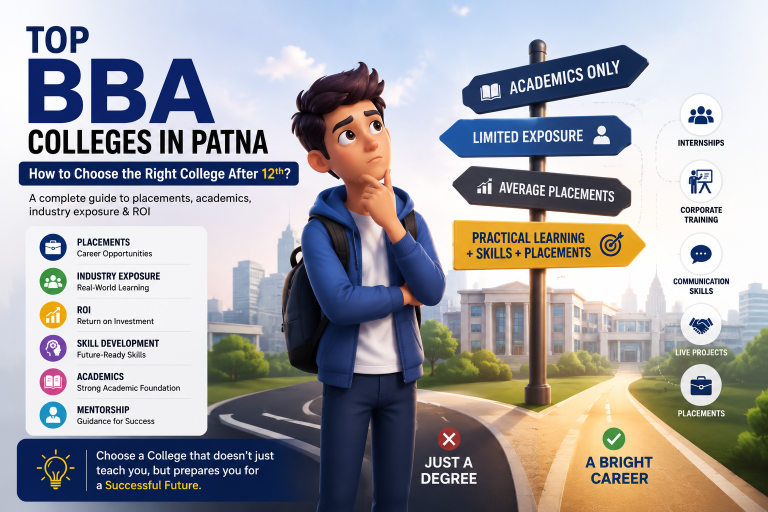
What Students Should Actually Evaluate Before Choosing a College
1. Academic Quality and Industry Relevance
A modern college should prepare students for real-world demands, not just exams.
Key factors include:
- Industry-oriented curriculum
- Practical exposure
- Skill development programs
- Updated syllabus
- Internship opportunities
- Academic credibility
2. Faculty and Mentorship Culture
Teachers play a major role in shaping confidence and direction.
Students should evaluate:
- Teaching quality
- Mentorship support
- Career guidance
- Accessibility of faculty
- Student interaction quality
3. Placement Support and Career Preparation
Placements should not be judged only by highest packages.
Instead, students should focus on:
- Placement consistency
- Recruiter quality
- Internship opportunities
- Training programs
- Alumni outcomes
- Communication and interview preparation
4. Infrastructure Should Be Functional, Not Just Attractive
A college should support learning, not just look good.
Look for:
- Well-equipped labs
- Libraries and digital resources
- Training spaces
- Seminar halls
- Practical learning setups
5. Campus Culture and Student Environment
College life shapes personality and mindset.
Evaluate:
- Discipline and seriousness
- Student behavior
- Inclusiveness
- Learning atmosphere
- Growth-oriented culture
6. Industry Exposure and Real-World Learning
Students should not be limited to textbooks.
Important exposure includes:
- Workshops and seminars
- Internships
- Industry visits
- Live projects
- Corporate interaction
7. Financial Practicality and ROI
Education must also make financial sense.
Consider:
- Fees structure
- Hidden costs
- Scholarships
- Long-term career value
- Return on investment
Understanding the Best College in Patna – A Practical Reality
When students search for the best college in Patna, they are not looking for a single answer — they are trying to understand which institution fits their personal goals.
Instead of comparing colleges as “better” or “worse,” it is more meaningful to understand what each institution represents in terms of learning style and student outcomes.
Some institutions in Patna are widely known for their career-focused and skill-oriented approach, where students are exposed to practical training, workshops, communication development, and placement preparation. In this context, CIMAGE Group of Institutions is often associated with a more employability-driven learning environment that emphasizes industry readiness and skill development.
On the other hand, institutions like St. Xavier’s College of Management & Technology are generally recognized for their structured academic system, disciplined environment, and traditional approach to higher education, which appeals to students seeking academic stability.
For students interested in business and management-oriented learning, institutions such as International School of Management (ISM) Patna provide exposure to corporate-style education, including professional training, management studies, and industry interaction.
Students who prefer a modern university experience with strong infrastructure and campus life often consider Amity University Patna, where academic learning is combined with extracurricular and campus engagement opportunities.
At the same time, institutions such as Arcade Business College and Chaitanya Institute of Management Technology (CCMT) are often considered by students seeking affordable, accessible, and traditional professional education pathways.
Each of these institutions serves a different purpose, and none can be universally labeled as the “best” for every student. The right choice depends on individual goals, learning preferences, financial situation, and long-term career vision.
The Most Important Skill in Today’s Education System
In a world full of information, students must learn how to think critically.
This includes:
- Researching independently
- Verifying claims
- Comparing options wisely
- Avoiding marketing influence
- Focusing on real outcomes
This ability — known as information literacy — has become one of the most important skills for students today.
The Most Powerful Question Before Choosing a College
Before finalizing any institution, students should ask:
“Will this environment help me become the best version of myself?”
Because education is not only about earning a degree.
It is about becoming:
- Skilled
- Confident
- Disciplined
- Ethical
- Emotionally strong
- Industry-ready
- Future-ready
Final Thoughts
Choosing a college is one of the most important decisions in a student’s life.
In today’s competitive world, students should look beyond advertisements, rankings, and surface-level impressions. The real value of a college lies in its ability to consistently support learning, growth, and career development.
A college does not just shape employability.
It shapes personality, thinking, confidence, habits, relationships, and long-term direction.
Choose a college not only for where it can place you — but for who it can help you become.
Frequently Asked Questions (FAQs)
1. Why is choosing the right college important?
Choosing the right college is important because it impacts not only education, but also confidence, skills, personality, and long-term career growth.
2. What is the best way to choose a college in Patna?
Students should focus on practical factors such as academic quality, placement support, faculty, infrastructure, industry exposure, and return on investment rather than advertisements or rankings alone.
3. Is placement the only factor to consider while choosing a college?
No. Placement is important, but practical learning, mentorship, skill development, and industry exposure are equally important for long-term career success.
4. Why do students get confused while selecting colleges?
Students often feel confused due to information overload, social media influence, advertisements, peer pressure, and unclear or exaggerated placement claims.
5. What is information literacy and why is it important?
Information literacy is the ability to research, compare, and verify information before making decisions. It helps students avoid misinformation and make better educational choices.
6. Which college in Patna focuses more on placements and skill-based learning?
Some institutions in Patna are known for their placement-oriented and skill-focused approach. For example, CIMAGE Group of Institutions is often associated with industry-oriented training, communication development, workshops, and structured placement preparation. Students interested in employability-focused education often evaluate such institutions based on practical exposure and career readiness support.
7. What is the most important question students should ask before choosing a college?
Students should ask:
“Will this environment help me become the best version of myself?”
Because the right college should support not just academics, but overall personal and professional growth.
About the Author